
North Carolina
School Bus Stoparm Camera Systems (Pilot Project report)
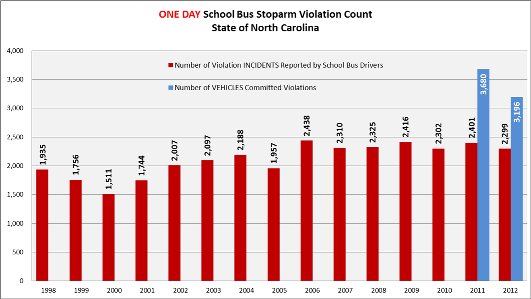
Results report for 2014-2015 prepared by the Institute for Transportation Research and Education, funded by the Governor’s Highway Safety Program. The Problem During a one-day count in 2012, North Carolina school bus drivers witnessed 3,196 vehicles illegally passing stopped school buses at 2,299 bus stops. These violations occurred while the buses were stopped, stoparm extended with flashing red lights, and children were in the process of embarking or disembarking buses. These one-day school stoparm violation reports have been collected by North Carolina public schools since 1999 (right) and they reveal a persistent problem which exposes school children to danger at bus stops. |
 |
The Solution: Legislative & Technology Approaches
| In the last ten years, North Carolina legislature's have passed successive bills that increased penalties and closed loopholes on school stoparm violations (Table 1). The 2009, House Bill 440 (Nicholas Adkins School Bus Safety Act in memory of the 16 year old student killed when a driver did not stop for a stopped school bus), added one critical provision to an existing law - allowing the use of automated camera and video recording systems to detect and prosecute violators. | NC School Bus Stop Arm Legislations |
|||
|
||||
|
||||
|
||||
|
||||
House Bill 440 opened up an opportunity to use video technology to capture illegal passing events, vehicle makes, models, license numbers, and most importantly, images of the offending drivers. These are all required elements in order to seek stoparm violation prosecution in North Carolina. The technology to capture the passing event and vehicle information can be retooled using the traditional onboard school bus camera system. However, these camera systems have often failed to capture the offending driver's image. In 2011, with funding from the North Carolina Governors Highway Safety Program, North Carolina Department of Public Instruction and the Institute for Transportation Research and Education at NC State University, issued a Request for Proposal for a dedicated stoparm violation camera system capable of capturing the passing event, vehicle information, and violator's images. |
|
.jpg) |
|
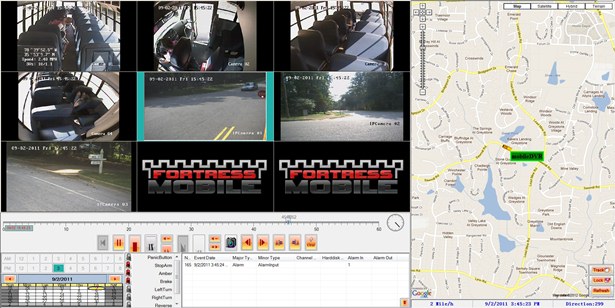
These exterior and interior video cameras are recording continuously during a bus route. The recording system captures the following bus activities: speed, braking, deployment of amber warning lights and deployment of stoparm (below). |
|
.jpg)
 |
|
| Once a stoparm violation is observed, the bus driver triggers a sensor to time-mark the video. Embedded with GPS and mapping, the playback software enables the transportation department to study the passing events in detail. They can toggle through different cameras to study the image frame by frame with local law enforcement. | |
|
The offending driver had more than sufficient time to stop. Notice the student checking phone while crossing the road. The driver pleaded guilty to the stoparm violation. |
|
|
The offending driver was issued a citation and the case was continued 4 times. At the last court date the subpoenaed bus driver fail to show and the case was dismissed. |
|
|
Three students disembark the bus, vehicle committed the violation at high school between the second and third students’ crossing. No citation was issued due to equipment problem. |
|
View the Cumberland County Video Video from earlier camera system captured 7 vehicles passing from behind on 4-lane roadway with medium separation. No citation was issued because this system was not designed to capture offend driver’s image. |
|
View the Stanly County Video Video clearly shows bus coming to a stop and extending the stop arm. Two vehicles come to a complete stop and After one child crosses the street the first vehicle passes the stopped bus. Moments later a second child crosses the street. Driver pleaded to a reduced citation of improper movement. |
|
|
Video shows a student using electronic devices, properly looking left (but not right), looking at the driver for the hand signal, and after she crosses, a log truck comes around the curve, swerves to keep from hitting the bus, and ends up passing the stop arm, finally coming to a stop at the bus stop. Note – we removed 7 seconds from the video to the time from when the student crossed until the truck enters the picture is actually 7 seconds longer. Regardless, it was a close call. |
State Reporting
North Carolina Public Schools Reporting School districts in North Carolina are encouraged to provide information on stop arm violations resulting from an incident where the violation is captured on video. There is a place to record violations that were NOT forwarded to law enforcement as well as those where violators are being prosecuted. Record violations HERE. |